Witnesses relive ‘Hand of God’ goal, other classic Argentina-England moments - The Globe and Mail
An unexpected moment of rivalry occurred on the freeway in Atlanta as the team buses for England and Argentina converged en route to the Mercedes-Benz Stadium for their World Cup semi-final clash. Despite detailed coordination by FIFA and host cities regarding team departures and arrival routes, the two buses, both with police escorts, met on the way to the stadium.
During the pre-game broadcast, it was observed that the Argentina team bus had to pause on the freeway, allowing the England bus to pass it. This incident provided an early, albeit unconventional, competitive moment between the two national teams before they even took to the field.
Historical Rivalry Moments
The encounter in Atlanta adds another chapter to a long-standing rivalry between England and Argentina, marked by several memorable and often controversial moments in World Cup history. These events have transcended sport, becoming significant parts of the political and cultural narratives of both nations.
One such defining incident occurred in 1966 during a World Cup quarter-final at London‘s Wembley Stadium. Argentina midfielder Antonio Rattin was sent off in the first half but refused to leave the pitch, causing a significant delay in the game. Rex Gowar, who attended the match, recalled the surprise at Rattin‘s actions, as he continuously questioned the referee’s decisions against Argentina for fouls. England ultimately won that match 1-0, with Geoff Hurst scoring the decisive goal, and went on to win the World Cup that year.
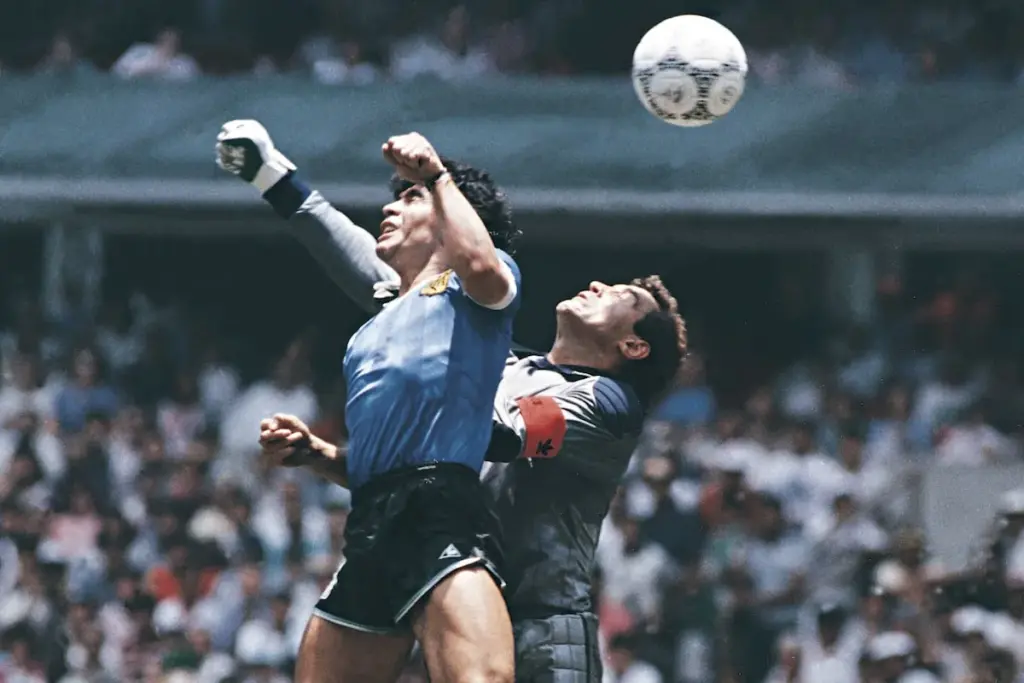
Twenty years later, in 1986, the teams met again in a quarter-final at the Azteca Stadium in Mexico City. This match took place just four years after a conflict between Argentina and Britain over the Falkland Islands, known as the Malvinas by Argentines. Photographer Gary Hershorn, covering his first World Cup, noted the geopolitical significance of the game. During this match, Diego Maradona scored two quick goals in the second half. The first of these, famously known as the “Hand of God” goal, was a moment many present did not immediately recognize. Hershorn, positioned at the opposite end of the field, did not witness or photograph the incident as it happened, only becoming aware of its magnitude later.
Rex Gowar, present as a reporter, also missed the immediate impact of the “Hand of God” goal from the press box, though a colleague quickly identified that Maradona had used his hand. Gowar was instrumental in relaying Maradona‘s subsequent quote, “a little with the head of Maradona and a little with the hand of God,” to the world. Argentina won that match 2-1 and eventually lifted the trophy.
Later Encounters and Reactions
The rivalry continued in 1998 when the teams faced each other in the last 16 in St. Etienne, France. Nigel Martyn, England‘s reserve goalkeeper at the time, remembered the intense focus on winning the game, noting that the media amplified the rivalry. The first half concluded with a 2-2 scoreline. Shortly after the break, David Beckham received a red card for kicking out at Diego Simeone. England subsequently lost the match on penalties, and Beckham faced significant criticism from both media and fans.
Martyn felt that the red card was harsh and that the criticism directed at Beckham was unjust, emphasizing Beckham‘s dedication to the team and his distress over the sending off and the team’s elimination from the tournament. Four years later, in the 2002 World Cup, England secured a 1-0 victory against Argentina with a penalty from Beckham, a match that Martyn described as feeling like a “grudge match” and a form of revenge, as Argentina failed to advance from the group stage that year.
The recent freeway incident in Atlanta, where Argentina‘s bus had to wait for England‘s bus to pass, adds a minor, yet symbolic, moment to this storied rivalry ahead of their semi-final match.
Source: theglobeandmail.com