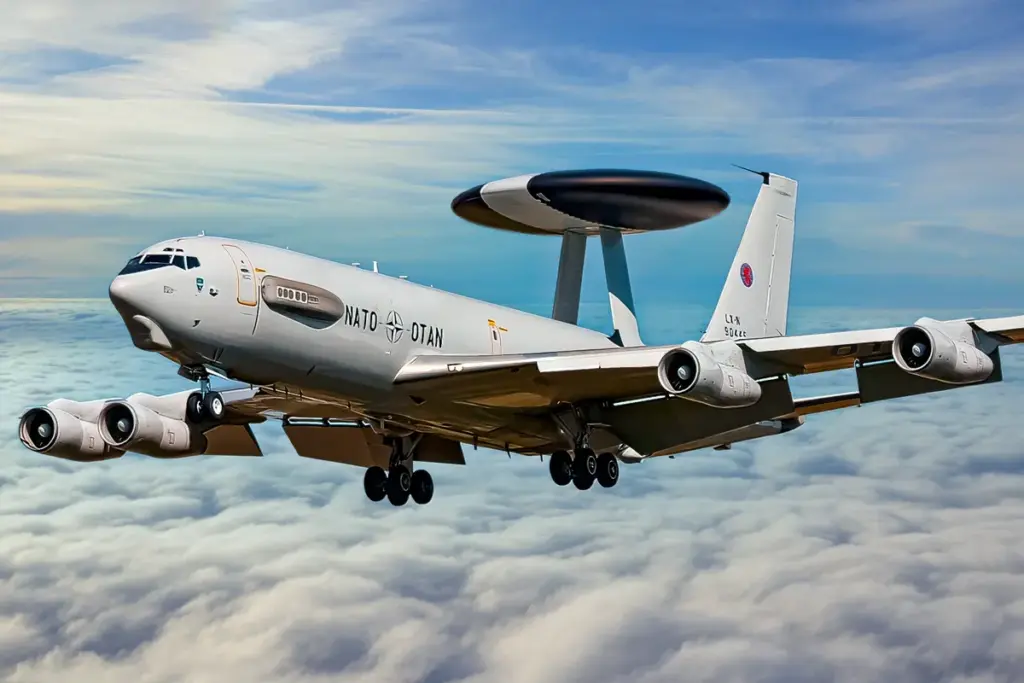
In a significant development, an Iranian strike on March 30, 2026, has destroyed an E-3 Sentry AWACS aircraft stationed at Prince Sultan Air Base in Saudi Arabia. This incident marks a troubling escalation in regional tensions and raises serious concerns regarding U.S. military surveillance capabilities.
The E-3 Sentry, an airborne warning and control system, was one of 16 such aircraft in the U.S. fleet before the attack. This aircraft is crucial for monitoring airspace, capable of tracking around 600 targets simultaneously and overseeing a battlespace of up to 120,000 square miles.
The loss of the E-3 Sentry is particularly alarming as it represents a significant reduction in the U.S. Air Force’s surveillance assets. The fleet has already dwindled from 32 aircraft in 2015 to just 17 at the beginning of 2026, highlighting ongoing concerns about the aging fleet and the need for replacements.
Experts have voiced their concerns regarding the implications of this strike. Andreas Krieg noted, “Iran is gradually eating away at the network of early warning systems that the US has built over decades in the region.” Similarly, Cedric Leighton stated, “The loss of the AWACS is a serious blow to (US) surveillance capabilities.”
As the situation unfolds, uncertainties remain. It is unclear whether any Oklahoma-based crews were present during the attack, and the extent of damage to U.S. forces and assets in the region is not fully confirmed. Details remain unconfirmed.
Kelly Grieco emphasized the broader implications, stating, “Iran’s going after the radars that detect threats, the tankers that keep jets flying, and the AWACS that direct the battle.” This coordinated strategy by Iran poses a significant challenge to U.S. military operations in the area.
As the Pentagon continues to explore options for replacing the aging E-3 fleet, the urgency of addressing these vulnerabilities has never been more apparent. The attack serves as a stark reminder of the evolving threats in the region and the need for a robust response.
In the wake of this incident, reactions from military analysts and officials are expected to shape future U.S. strategies in the Middle East. Daniel Davis succinctly stated, “We’re not doing OK at all,” reflecting the gravity of the situation.
The destruction of the E-3 Sentry AWACS aircraft not only impacts immediate military operations but also signals a shift in the balance of power in the region, prompting discussions about the future of U.S. military presence in the Middle East.