World Cup final data pointers: Spain’s defensive record and Argentina’s attack
Anticipating the World Cup final
The World Cup final on Sunday evening will feature Argentina and Spain, marking the first time the champions of South America and Europe have met in this championship match. Both teams are highly ranked, with Argentina and Spain holding the top two positions in FIFA’s world ranking for men’s international teams. Opta’s supercomputer had rated Luis de la Fuente‘s Spain as favourites to win the tournament, while their opponents were considered fourth likeliest.
Both systems had also placed England and France within their top four, suggesting that the semi-finals featured the expected teams. However, the tournament’s statistics indicate that the final pairing might be closer than initial predictions suggested.
Team strengths and tactical approaches
Spain enters the final with an impressive record, being unbeaten in 37 matches, excluding penalty shootouts. Argentina has also demonstrated strong form, winning their past 14 games. These records provide a solid foundation for their presence in the final.
Both teams are among the leaders in expected goals, though penalties have contributed to their figures. When excluding penalties and adjusting for time played, several teams had better pro-rata records. However, no team that reached the quarter-finals outperformed their non-penalty expected goals per 90 minutes by more than Argentina.
Spain‘s defensive record has been particularly notable, conceding only 2.15 expected goals throughout the tournament, which averages out to a low 0.31 per match. This represents an elite level of defensive consistency across seven games. Many teams allowed their opponents more than 2.15 expected goals in their first match, with 41 teams surpassing that mark by the end of the group stage.
While Spain‘s defensive prowess is significant, Argentina has also shown resilience. Argentina was the last of the other 47 teams to concede more than 2.15 expected goals, which occurred when Yasser Ibrahim put Egypt ahead in the last-16. Although Argentina cannot match Spain‘s defensive record, they have maintained a close pace.
Set pieces are unlikely to be a decisive factor, as both sides possess strong defences in dead-ball situations without being particularly strong in attack. Despite this, Lionel Messi has taken the most shots on either side with 34, including two penalties. Lamine Yamal is second with 23 shots, followed by Mikel Oyarzabal with 22 shots, one of which was a penalty.
Mikel Oyarzabal has the best expected goals per shot average for either team at 0.15, among players with at least 10 shots. Players like Mikel Merino (0.35) and Lautaro Martínez (0.22) have higher figures and could play crucial roles from the bench, as they are adept at converting significant opportunities in key moments. Given the similar strengths of both teams, a substitute may prove decisive.
Spain has been described as the tournament’s standout side, while Argentina has built their run on resilience, experience, and the consistent brilliance of Lionel Messi. Spain‘s defence has conceded only once in seven games and has not trailed for a single minute. Their collective discipline in executing their system has been a defining characteristic.
In their semi-final match, Spain effectively neutralised France, preventing them from registering a shot on target until the 81st minute and limiting them to just 0.3 expected goals. This was the lowest expected goals figure for any team in a World Cup semi-final since 1994, highlighting Spain‘s tactical and technical superiority.
Argentina, the defending champions, are the tournament’s top scorers. They have not been ahead at the 90th minute in any knockout tie but have managed to win every one, often through dramatic comebacks. A notable example was their match against Egypt, where they trailed 2-0 until the final 10 minutes before securing a win in regulation time.
Lionel Scaloni‘s tactical flexibility has been key for Argentina, as he has switched between formations such as a 4-3-3, a 4-4-2, and a back five throughout the tournament. This adaptability allows Argentina to be flexible both in and out of possession. Julián Alvarez sets the tone without the ball, having applied more high-intensity pressures in the opposition half than any other player across the last two World Cups.
In possession, Argentina creates overloads across the pitch. Out of possession, they are willing to disrupt opponents’ rhythm with tactical fouls, a strategy they used effectively against England and may employ against Spain. Argentina is also comfortable dominating possession, as shown by retaining 88% possession after taking control against England. They lead the World Cup in through balls, which could exploit Spain‘s press, and only Spain has produced more sequences of 10 or more passes.
Spain‘s defence has forced opponents into poor-quality shots, conceding just 0.05 expected goals per shot, the lowest in the competition. However, Argentina has scored the most goals in the tournament, including five from outside the box, which is the joint-most, and they also lead in headed and set-piece goals. Spain‘s full-backs, such as Pedro Porro, have been central to maintaining width and creating opportunities by drawing defenders away from players like Lamine Yamal.
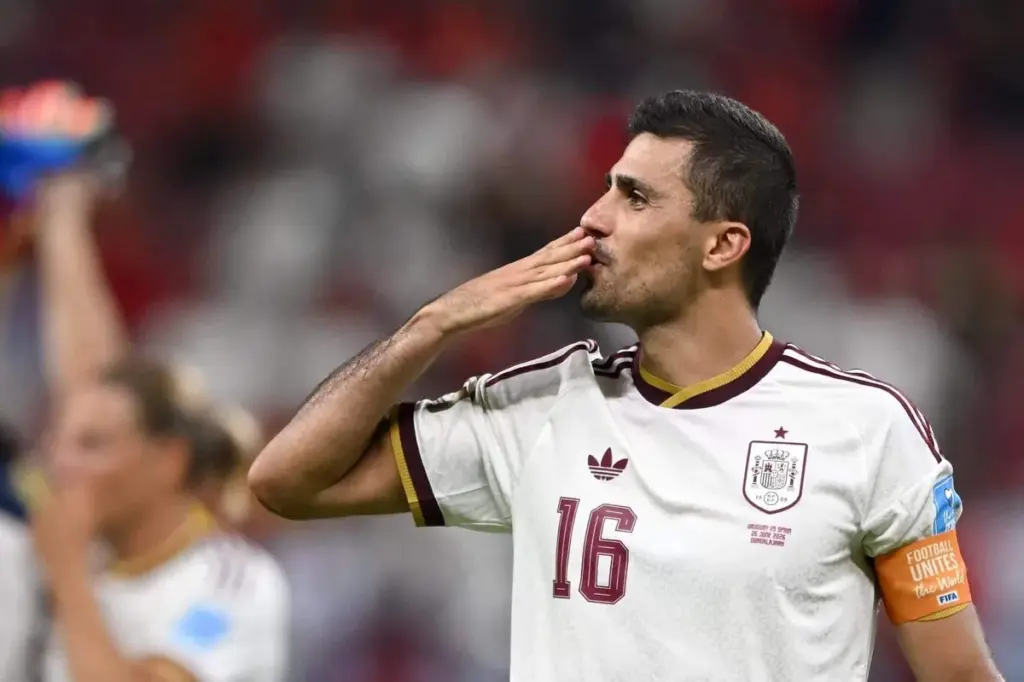
Messi has been involved in 52.7% of Argentina‘s shots and has contributed to 12 of their 19 goals. His ability to be decisive when it matters, even after long periods of anonymity, has been a consistent theme throughout the tournament. The task of limiting Messi will largely fall to Spain‘s midfielders, particularly Rodri, who patrols the area where 19% of Messi‘s touches occur.
The match is scheduled for Sunday evening at 9 PM.

Historical context and predictions
The rivalry between Spain and Argentina is perfectly balanced, with each side having six wins and two draws in their head-to-head encounters. This historical parity adds another layer of intrigue to the final.
Opta gives Spain a 45% chance of winning in 90 minutes, with Argentina rated at 26%. However, the tournament data suggests the match should be closer than these predictions imply.
The final will be broadcast on M6 and beIN SPORTS.
Source: theguardian.com