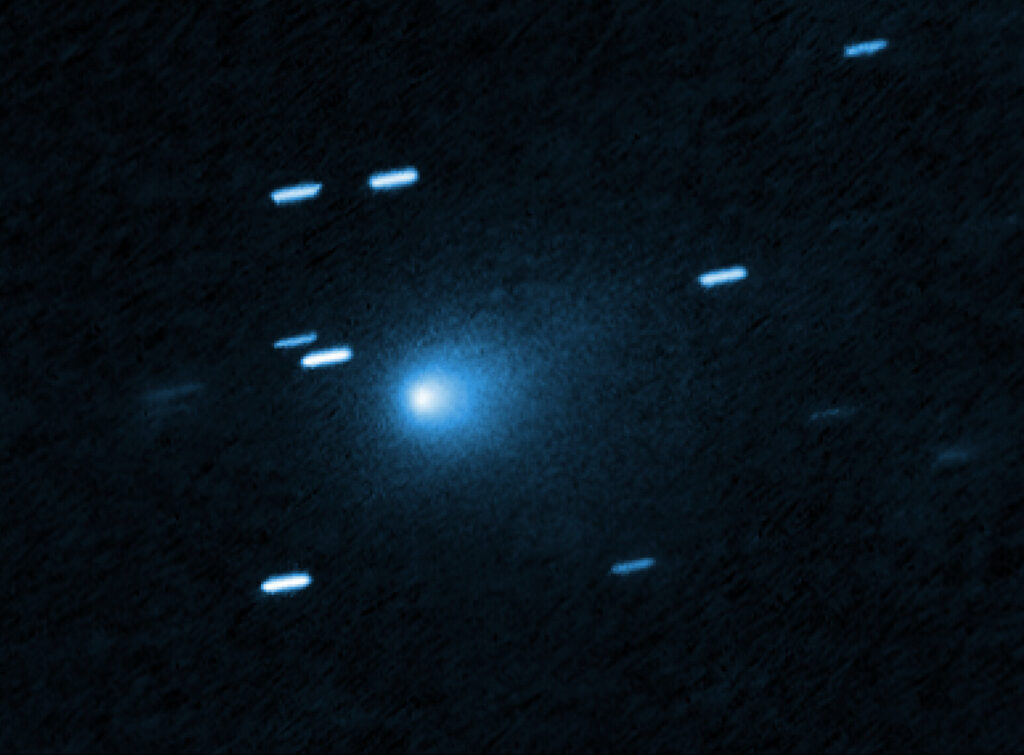
Introduction
The discovery of interstellar comet 3I/ATLAS has captured the attention of astronomers and space enthusiasts around the globe. Identified in 2019, this cosmic visitor is significant not only because it comes from outside our solar system, but also due to what it may reveal about the formation of celestial bodies and the conditions in distant star systems. In an era where the study of comets provides crucial insights into the building blocks of planetary systems, 3I/ATLAS stands out as a fascinating subject for further exploration.
The Journey of Comet 3I/ATLAS
3I/ATLAS was first detected by astronomers on December 2, 2019, using the ATLAS (Asteroid Terrestrial-impact Last Alert System) telescope in Hawaii. Following its initial detection, astronomers quickly recognized its hyperbolic trajectory as indicative of an interstellar origin. Since its discovery, 3I/ATLAS has been closely observed as it made its way through our solar system, passing closest to the Sun on May 31, 2020, at a distance of about 37 million kilometers.
The comet exhibited a coma — a cloud of gas and dust surrounding its nucleus — and a visible tail, allowing for detailed study and imaging. Experts have reported that 3I/ATLAS is relatively small compared to traditional comets, with an estimated size of approximately 100 meters. However, due to its high speed and unusual composition, it provides unique data that can help scientists understand the nature and evolution of such objects as they travel across the galaxy.
Scientific Significance
The analysis of 3I/ATLAS has importance beyond its striking appearance. Comets like 3I/ATLAS carry ancient material from the outer regions of their parent star systems, providing a window into the processes of formation and evolution that govern these distant worlds. Observations of the comet’s composition have already led to theories regarding its origins, suggesting that it could have originated in a more distant, possibly even alien, environment.
Additionally, the study of interstellar comets is crucial for understanding how these objects interact with the solar wind and the interstellar medium. As scientists continue to analyze the data collected during its brief visitation, they hope to glean insights that could help us answer fundamental questions about solar system formation and the types of materials that populate the universe.
Conclusion
As the study of interstellar objects continues to evolve, 3I/ATLAS serves as a significant milestone in our exploration of comets beyond our solar system. The insights gained from such studies pave the way for future research, expanding our understanding of not only our cosmic neighborhood but the universe as a whole. With the rise of new astronomical techniques and technologies, it is likely that more interstellar visitors will be detected, offering further opportunities for discovery and intrigue in celestial sciences.