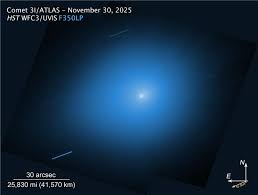
Introduction to Interstellar Comet 3I/ATLAS
The discovery of interstellar comet 3I/ATLAS is a remarkable achievement in the field of astronomy. It marks the second known comet from outside our solar system, following the famous ‘Oumuamua’ that was detected in 2017. The significance of these interstellar objects lies not only in their origins but also in the information they can provide about the formation of our solar system and the universe at large.
Details and Observations
NASA’s wide-field survey telescope, the Asteroid Terrestrial-impact Last Alert System (ATLAS), discovered this comet in late 2019. Its official designation, 3I/ATLAS, denotes it as the third interstellar object identified, following observations confirming its trajectory as coming from another star system. The comet has a hyperbolic trajectory, which suggests that it originated outside the gravitational influence of our sun.
As the comet approached our solar system, astronomers from various organizations, including the European Southern Observatory and universities, began to study its path and physical characteristics. Initial observations indicated that 3I/ATLAS possesses a peculiar shape, likely elongated due to the effects of gravitational forces during its journey. Studies suggest that the comet is composed of a mixture of ice and rock, similar to other comets but with unique properties pertinent to its interstellar nature.
Scientific Importance
The study of 3I/ATLAS holds significant importance for understanding the chemical processes that take place in other star systems. By analyzing the composition of this comet, researchers hope to glean insights regarding the materials that form planetary systems and the potential for life beyond our own. The comet’s journey through our solar system provides a rare opportunity to observe an object that has traveled across the Milky Way, possibly hinting at the building blocks of life.
Conclusion and Future Prospects
As astronomers continue to gather data on 3I/ATLAS, future observations could shed light on its properties and origins, enriching our understanding of interstellar objects. With the advancements in astronomical technology and international collaboration, the scientific community is excited about ongoing research related to this comet and the implications it holds for our knowledge of the cosmos. The continued exploration of such phenomena reaffirms the importance of space research and fuels curiosity about the universe and our place within it.