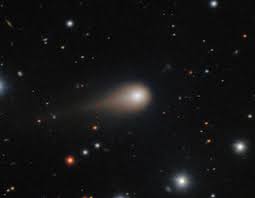
Introduction to Interstellar Comet 3I Atlas
The interstellar comet 3I Atlas, discovered by NASA, is bringing a wave of excitement and curiosity within the scientific community and the public alike. This comet, which has traveled billions of years across the cosmos, offers unique insights into the formation and characteristics of celestial bodies beyond our solar system. Its existence marks the second confirmed interstellar comet, following ‘Oumuamua, which was detected in 2017.
Discovery and Characteristics
The NASA-funded Astrobiology Institute reported that 3I Atlas was first observed on December 19, 2021, using the Asteroid Terrestrial-impact Last Alert System (ATLAS) in Hawaii. As it approached our solar system, astronomers quickly recognized its interstellar origin due to its hyperbolic trajectory – a movement pattern that indicates it is not bound by the sun’s gravity.
Comet 3I Atlas is approximately 1,000 feet (300 meters) in diameter with a distinctive shape and coloration that suggests it is composed of ice and dust, similar to other comets. Analyzing its composition can help scientists understand the materials present during the early stages of the solar system and by extension, the universe.
Scientific Importance
The study of interstellar comets like 3I Atlas is crucial as it allows scientists to examine materials from outside our solar neighborhood. Researchers have noted that studying the chemistry and physics of interstellar comets can reveal how comets form, their role in delivering water and organic materials to planets, and other phenomena related to planetary formation.
Furthermore, observatories around the world are actively monitoring 3I Atlas for its change in brightness and signs of activity as it gets closer to the sun. Such efforts can provide further understanding of how interstellar bodies behave when they interact with solar radiation and wind.
Conclusion and Future Implications
The discovery of interstellar comet 3I Atlas is not just a scientific milestone; it prompts deeper investigation into the origins of comets and planetary systems throughout the galaxy. As humanity continues to explore the cosmos, comets like 3I Atlas remind us of the vastness of space and the many mysteries that lie beyond our own solar system. Its study promises not only to enhance our understanding of cosmic materials but could also lead to breakthroughs in the ongoing research of planetary systems and their evolution.