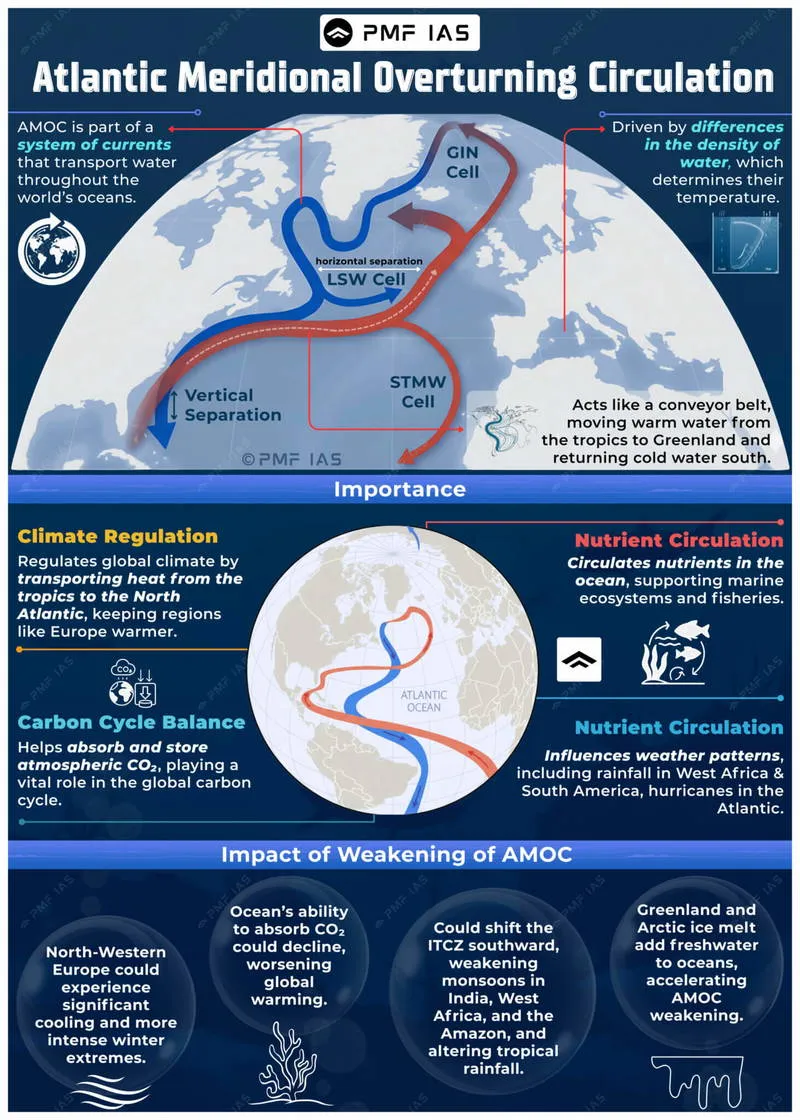
New research indicates that the Atlantic Meridional Overturning Circulation (AMOC) is at risk of collapse due to climate change, echoing scenarios depicted in popular media. The AMOC, a crucial system of ocean currents, has weakened by 10% in the past 20 years, raising alarms among scientists.
The AMOC acts like a conveyor belt, moving warm water north and cold water south. This process not only regulates temperatures but also influences weather patterns for hundreds of millions of people across the globe. As Niklas Boers emphasizes, “The Atlantic Meridional Overturning Circulation really is one of our planet’s key circulation systems.” Without it, our climate could face drastic shifts.
Historically, volcanic eruptions have caused rapid changes in the AMOC, leading to significant cooling periods. For instance, during the Younger Dryas period, temperatures dropped by several degrees in the Northern Hemisphere, likely altering ecosystems and forcing early humans to adapt to colder environments. Lucien Nana Yobo notes that these events illustrate how sensitive our climate system can be.
Today, threats to the AMOC primarily stem from excess carbon dioxide emissions due to human activities. This weakening can lead to decreased marine productivity in the North Atlantic—an outcome that could disrupt food chains and fisheries critical for local communities.
Current climate models suggest that increased greenhouse gases may further weaken the AMOC throughout this century. In response, researchers are exploring potential geoengineering solutions like damming the Bering Strait—a proposal that brings both promise and peril. As one expert cautions, “This study shows that large-scale technological interventions may be potential solutions, but they are fraught with risks and uncertainties; therefore, geoengineering should be viewed as a last resort rather than the primary solution to climate change.”
The implications of a collapsing AMOC are profound. It serves as a vital carbon sink—absorbing CO₂ from the atmosphere—and its failure could accelerate climate change effects globally. Jelle Sunes points out that under some conditions, “the AMOC remains more stable. Under other conditions, it may weaken,” highlighting the complex dynamics at play.
As we look ahead, communities around the North Atlantic should prepare for potential shifts in their climates and economies. The AMOC’s fate intertwines with our own—its collapse could bring about changes that affect everything from fishing industries to weather patterns.