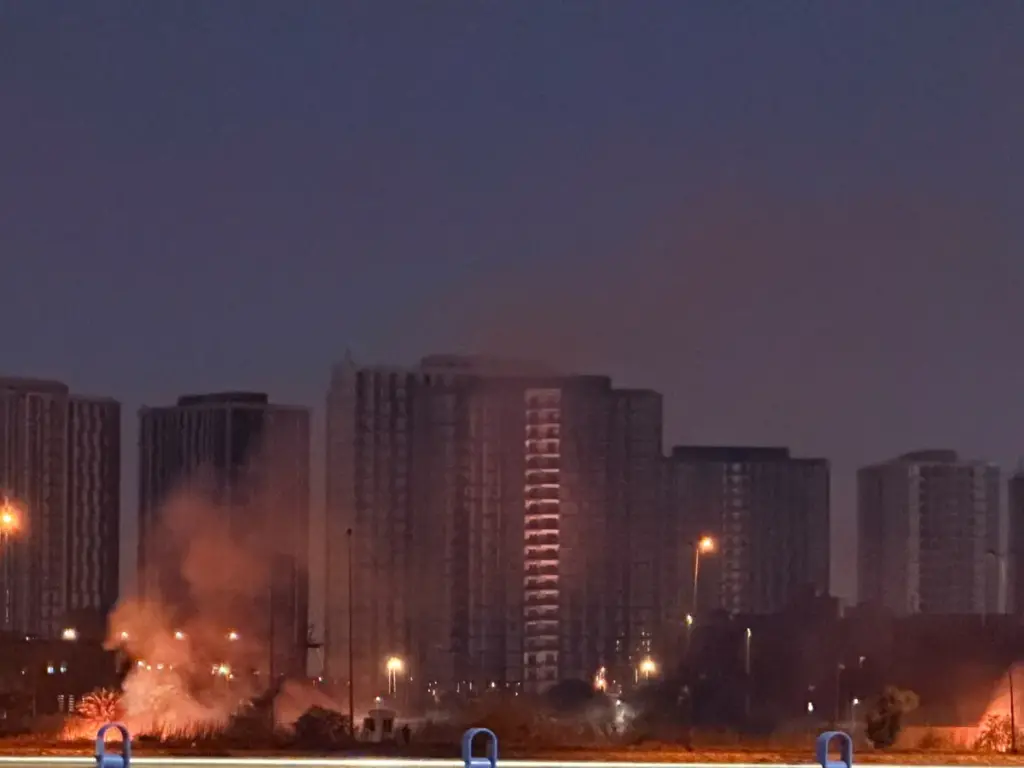
“We’ve had drone activity here in Baghdad’s Green Zone, where the US embassy is located,” reported Al Jazeera’s Assed Baig, following a series of explosions that rocked the area.
At least three explosive drones targeted a US diplomatic facility near Baghdad International Airport, with two drones intercepted and a third disappearing off radar. Debris from one of the aerial objects fell near the Central Bank in the al-Jadriyah district, although there were no immediate reports of casualties from the attacks.
The explosions are indicative of an escalating cycle of violence between US forces and Iraqi groups aligned with Tehran. Just a day prior, four individuals were killed in an air raid on a building used by the Popular Mobilisation Forces (PMF), an umbrella group of mostly Shia paramilitary factions founded in 2014 to combat ISIL (ISIS) advances.
Baig noted, “There’s really no let-up,” emphasizing the ongoing threat faced by Iraqis amid this turmoil. The attacks demonstrate the precarious security situation in Baghdad, where militia groups have conducted at least 292 attacks on US facilities since February 28.
In response to the escalating violence, the US has ordered all its embassies to review their security posture. The US military has struck more than 7,000 targets in its ongoing conflict with Iran, which has resulted in the deaths of at least 13 US service members and over 1,300 individuals in Iran, according to the Iranian Red Crescent.
As tensions continue to rise, a State Department spokesperson remarked, “The assembly of EACs is determined by a number of operational considerations and does not necessarily mean there is a specific threat.” This statement highlights the complexity of the current security landscape in the region.
Details remain unconfirmed regarding the full extent of the damage and the implications of these attacks. The situation in Baghdad remains fluid, with further developments expected as the US and its allies reassess their strategies in response to the ongoing violence.