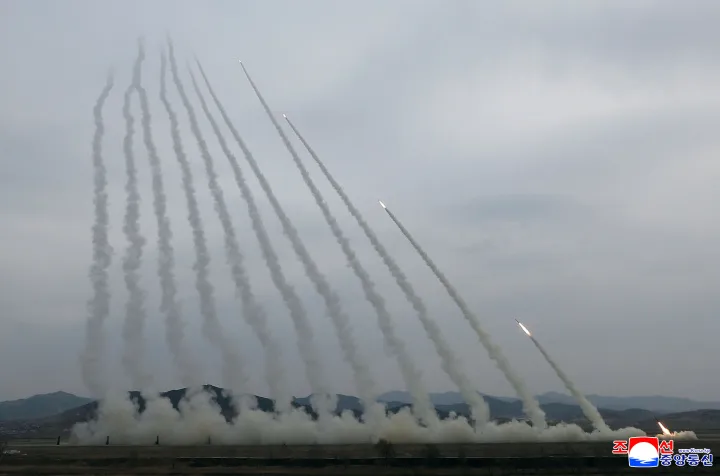
North Korea has a history of conducting missile tests during periods of heightened military activity by South Korea and the United States. On March 14, 2026, North Korea launched approximately ten ballistic missiles towards the Sea of Japan, marking a significant escalation in regional tensions.
The missiles were launched from the Sunan region in North Korea and traveled approximately 350 kilometers before landing in the Sea of Japan. This military exercise was conducted under the supervision of Kim Jong Un, who claimed that the new 600 mm multiple rocket launcher system demonstrated a range of 420 kilometers.
The missile tests coincided with joint military drills involving around 18,000 soldiers from South Korea and the United States, which North Korea perceives as a direct threat. The South Korean military detected the missile launches at 13:20 local time and condemned them as a provocation that violates UN Security Council resolutions.
In a statement, Kim Yo Jong warned of “terrible and unimaginable consequences” resulting from the ongoing military exercises by South Korea and the US. The North Korean state media reported that the rockets hit a target on an island in the East Sea with 100% accuracy, further asserting the effectiveness of their military capabilities.
These missile tests are seen as a demonstration of North Korea’s military capabilities amid rising regional tensions. Observers note that North Korea’s missile tests have been ongoing for several months, defying UN resolutions and raising concerns among neighboring countries.
As the situation develops, officials and analysts are closely monitoring North Korea’s military activities and the potential implications for regional security. The missile launches have heightened fears of further provocations from Pyongyang, particularly in the context of the ongoing military exercises in the region.
Details remain unconfirmed regarding the specific targets of the missile launches and the potential responses from Japan and South Korea. However, the international community is likely to respond with increased scrutiny of North Korea’s actions and continued diplomatic efforts to address the escalating tensions.