What Happened
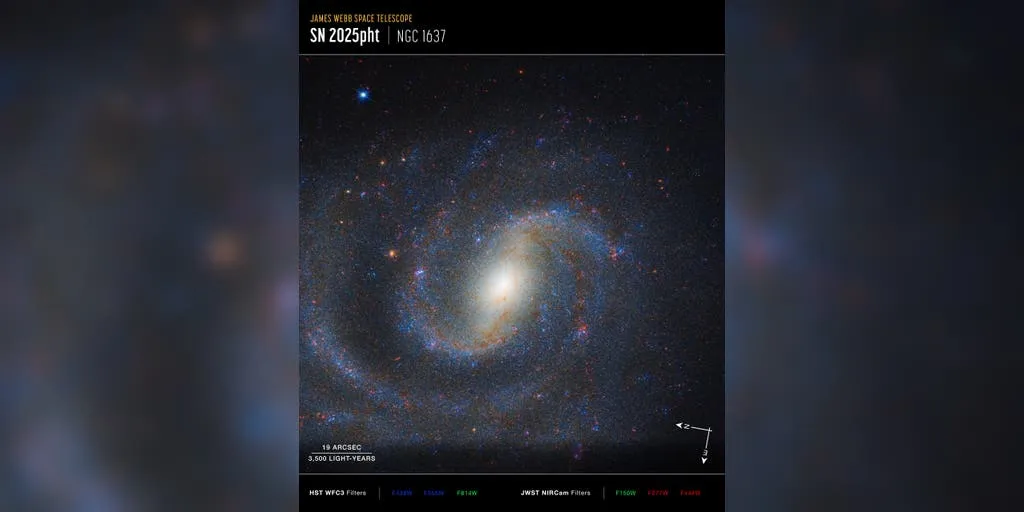
A team of astronomers from Northwestern University utilized NASA’s James Webb Space Telescope (JWST) to uncover significant findings regarding a former star that exploded over 40 million years ago in a nearby galaxy. The explosion, which produced a beacon of light, reached Earth on June 29, 2025. The researchers initially believed the supernova was a new event, but upon reviewing archival images from the Hubble Space Telescope, they identified the ancestral star.
In a separate study, scientists mapped the upper atmosphere of Uranus for the first time using the JWST. This research revealed unique features of the planet’s magnetic field and its auroras, which are influenced by Uranus’s unusual tilt.
Why It Matters
The discovery of the former star enhances our understanding of supernovae and their remnants, providing insights into stellar evolution and the lifecycle of stars. Lead author Charlie Kilpatrick emphasized the significance of observing a supernova in a galaxy previously studied by Webb, stating, “We’ve been waiting for this to happen.”
The findings regarding Uranus’s atmosphere are equally important, as they offer the most detailed portrait yet of how the planet’s auroras form and how they are affected by its tilted magnetic field. Study lead author Paola Tiranti noted that this research allows scientists to visualize Uranus’s upper atmosphere in three dimensions for the first time.
What’s Next
Following these discoveries, astronomers plan to continue utilizing the James Webb Space Telescope to further investigate the remnants of supernovae and the atmospheric dynamics of ice giants like Uranus. The ongoing research aims to deepen our understanding of cosmic phenomena and the behavior of planetary atmospheres in our solar system.