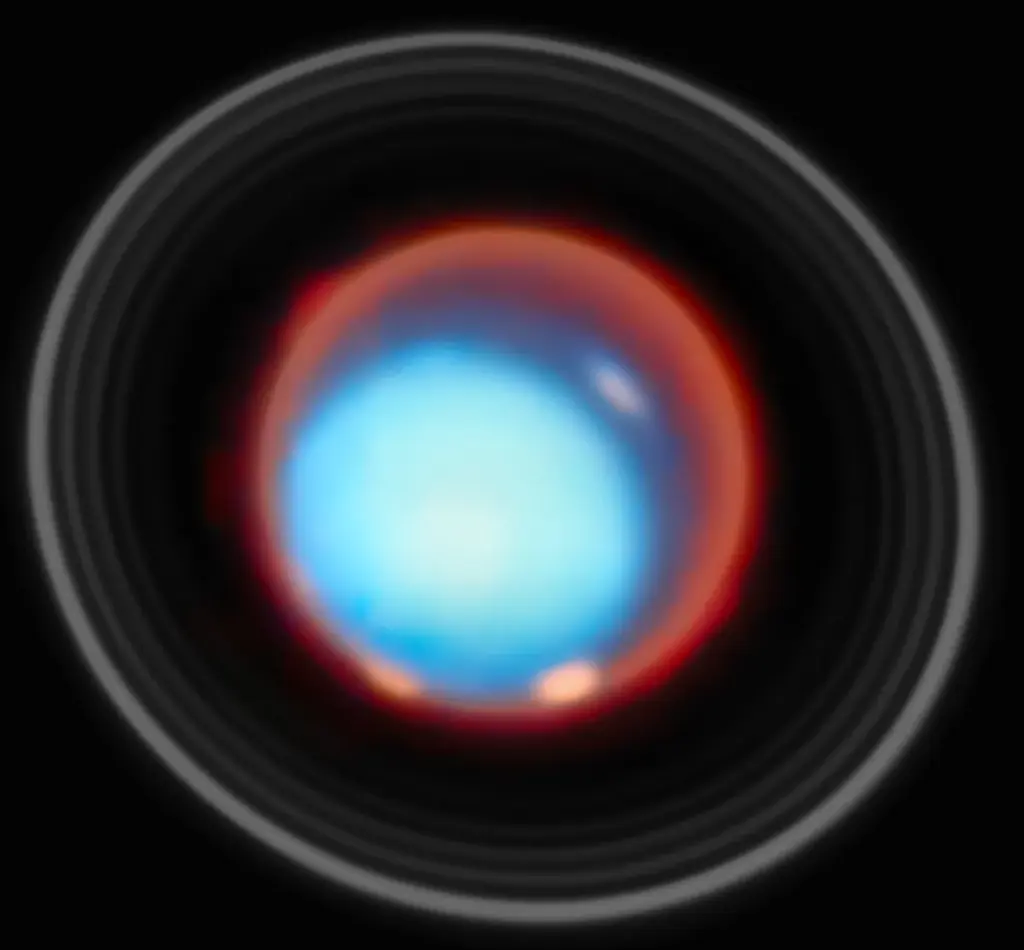
What Happened
NASA’s James Webb Space Telescope (JWST) has provided the first vertical view of Uranus’s ionosphere, revealing intricate auroras shaped by the planet’s uniquely tilted magnetic field. This groundbreaking image was released on February 19, 2026, showcasing the complex interactions between Uranus’s atmosphere and its magnetic field.
Why It Matters
The findings offer the most detailed portrait yet of where auroras form on Uranus and how the planet’s unusual magnetic field influences these phenomena. Uranus possesses the strangest magnetosphere in the Solar System, tilted at 60 degrees relative to its rotation axis. This tilt results in auroras that behave differently than those on Earth, extending far beyond the planet’s poles. Understanding these dynamics is crucial for gaining insights into ice-giant planets and their characteristics, which may also apply to similar planets outside our Solar System.
What’s Next
Researchers plan to continue studying Uranus’s magnetosphere and upper atmosphere to further explore how energy is distributed in these regions. The data collected by JWST will enhance our understanding of auroral activity on Uranus and may lead to new discoveries about the planet’s atmospheric cooling since the 1990s. As scientists delve deeper into the complexities of Uranus, the implications for planetary science and our understanding of the Solar System will expand.