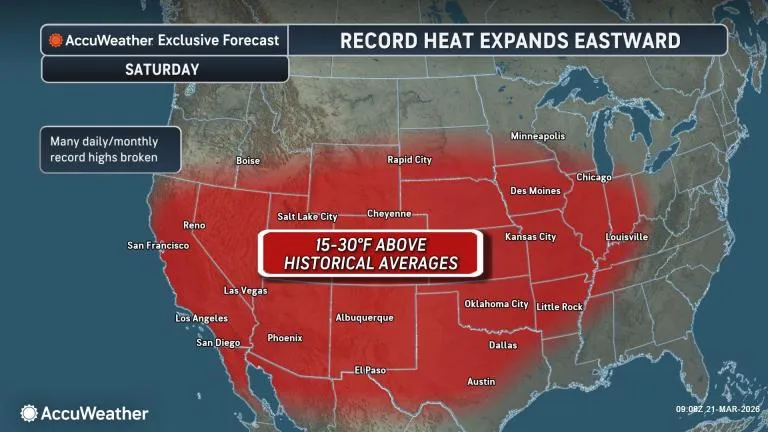
The Western United States is currently in the grip of a historic March heat wave, with temperatures soaring 15-30 degrees above normal. Palm Springs, California, has set a staggering new all-time March record high of 108 degrees Fahrenheit, while Las Vegas recorded an all-time March high of 97 degrees Fahrenheit. Phoenix is not far behind, reaching a record high of 105 degrees Fahrenheit.
San Francisco also broke its all-time March record high by an impressive 4 degrees, hitting 89 degrees Fahrenheit. This extreme weather is driven by a massive area of high pressure creating a ‘heat dome’ over the region, leading to unprecedented heat levels.
In Arizona, temperatures have reached as high as 110 degrees Fahrenheit, marking the highest March temperature recorded in the U.S. The rapid onset of this heat wave has prompted the closure of hiking trails due to the extreme heat and the risk of dehydration.
Experts are sounding the alarm, noting that the area of the U.S. affected by extreme weather has doubled in the past five years compared to two decades ago. The United States is breaking 77% more hot weather records now than it did in the 1970s, highlighting the alarming trend of increasing temperatures.
As temperatures continue to rise, daily records are expected to be broken each day through the weekend. The implications of this heat wave extend beyond immediate discomfort; the rapid thaw could prematurely deplete much of the snowpack, affecting water supply in late spring and summer.
Andrew Weaver, a climate scientist, remarked, “What used to be unprecedented events are now recurring features of a warming world.” This sentiment is echoed by Bernadette Woods Placky, who stated, “It’s really hard to even keep up with how extreme our extremes are becoming.”
Friederike Otto emphasized the role of climate change in these events, saying, “This is due to climate change, that we see more extreme events, and more intense ones and have so many records being broken.” As communities brace for the ongoing heat, the focus remains on how to adapt and respond to these increasingly common weather extremes.