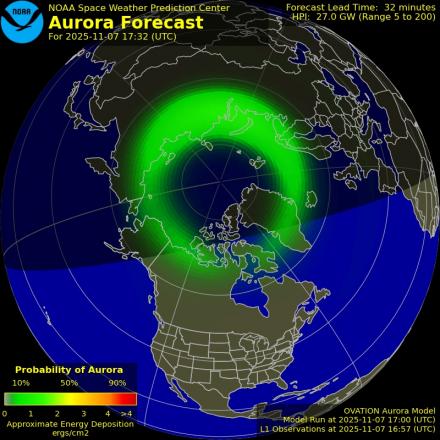
Introduction to Aurora Forecast
The aurora borealis, commonly known as the northern lights, is a captivating natural light display predominantly visible in high-latitude regions. As the activity from the sun interacts with the Earth’s magnetic field, spectacular visual phenomena occur in the night sky. The ability to forecast these occurrences has immense significance for sky watchers, researchers, and even the power sector, particularly in Canada and other polar regions.
Understanding Aurora Forecasting
Auroras are caused by charged particles from the sun colliding with the Earth’s atmosphere. Scientists utilize various tools such as satellite data from NASA and the European Space Agency, as well as ground-based observatories, to predict the strength and visibility of auroras. The primary factors influencing aurora activity include solar wind speed, density, and the interplanetary magnetic field’s orientation.
Current Events and Predictions
As of late October 2023, experts predict an uptick in auroral activity due to a recent coronal mass ejection (CME) from the sun, which is projected to hit Earth within days. This CME event has raised the aurora forecast index, particularly for regions in northern Canada where residents may experience vivid displays. The Canadian Space Agency (CSA) has issued alerts encouraging residents in places like the Yukon, Northwest Territories, and Nunavut to stay alert for potential aurora sightings.
Significance for Sky Watchers and Researchers
For sky watchers, the aurora forecast is not just a scientific curiosity; it represents a chance to witness one of nature’s most extraordinary light displays. Many enthusiasts plan trips to remote areas with little light pollution, often leading to tourism boosts in these regions during peak auroral activity. For researchers, increased auroral activity provides an opportunity to study the complex interactions between solar winds and the Earth’s magnetosphere, which can improve weather models that predict geomagnetic storms.
Conclusion
Keeping an eye on the aurora forecast is essential for both casual observers and serious researchers in Canada. With the recent rise in activity due to solar phenomena, now is an optimal time for individuals to venture outdoors and enjoy the spectacular northern lights. Looking ahead, as solar activity cycles approach their peak in the coming years, we can expect even more breathtaking displays, emphasizing the need for accurate forecasting to unlock nature’s wonders.