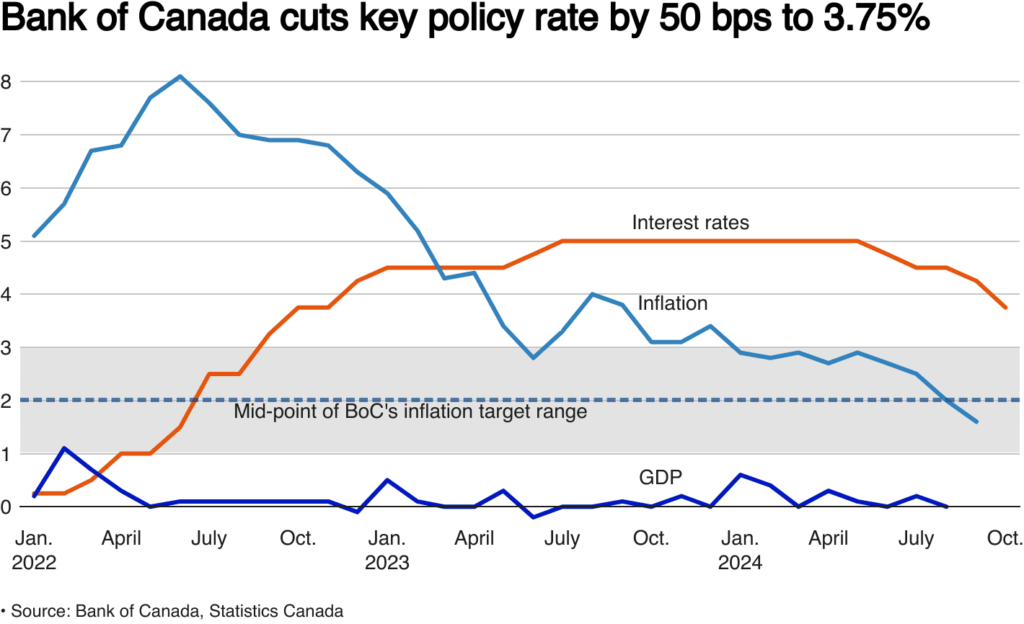
Importance of Interest Rate Cuts
Interest rates are a critical tool used by central banks, including the Bank of Canada, to regulate economic activity. By adjusting rates, the central bank influences borrowing, spending, and investment which impacts overall economic health. Recent announcements regarding interest rate cuts have sparked discussions among economists, policymakers, and consumers, emphasizing the significance of this financial mechanism.
Recent Developments
On October 25, 2023, the Bank of Canada made a significant decision to cut its benchmark interest rate from the previous 5.00% to 4.50%. This marked a noteworthy change after several months of steady rates aimed at controlling inflation. The decision was driven by a slowdown in economic growth and signs that inflation was beginning to stabilize.
According to the latest report from Statistics Canada, the annual inflation rate fell to 3.5% in September 2023, down from 4.1% the previous month. The slowdown in inflation has provided the Bank of Canada some leeway to reconsider its monetary policy approach. This cut is expected to lower borrowing costs for consumers and businesses, encouraging spending and investment during a time of economic uncertainty.
Impact on Borrowers and the Economy
The interest rate cut is expected to benefit a wide range of borrowers, including those with variable-rate mortgages and lines of credit, as their repayment amounts will decrease. For families and individuals, this could mean more disposable income, which may stimulate further spending in the economy.
Furthermore, businesses could benefit from lower borrowing costs, leading to increased investments in growth, hiring, and expansion. Economists predict that if the Bank of Canada’s strategy successfully boosts consumer spending and business investment, it could lead to a gradual economic recovery post-pandemic.
Future Outlook
Looking ahead, analysts will be closely monitoring any signs of economic recovery and labor market improvement. The Bank of Canada has indicated that it remains flexible with its monetary policy and will adjust as necessary, based on the economic climate. Following the interest rate cut, further adjustments could take place as the effects on inflation and economic activity become clearer.
In conclusion, the recent interest rate cuts by the Bank of Canada highlight the delicate balance central banks must navigate between stimulating economic growth and maintaining price stability. For consumers and businesses, these changes represent potentially significant opportunities for savings and investment, as the economy continues to recover from the challenges presented in recent years.