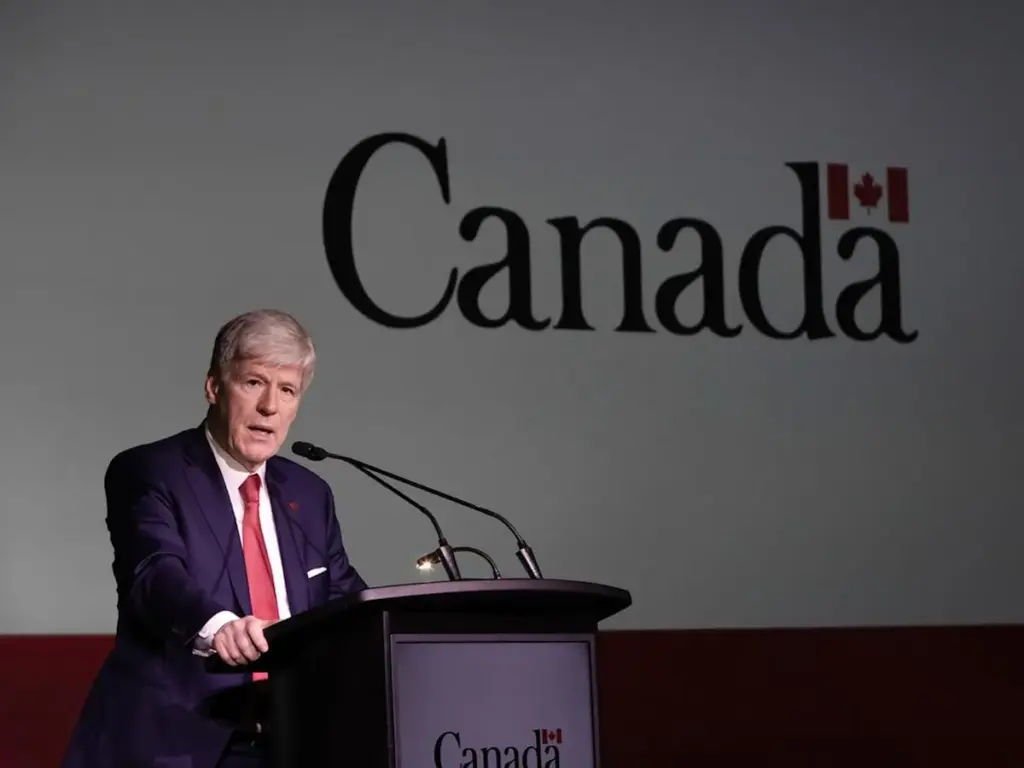
Tim Hodgson, the Federal Minister of Energy and Natural Resources, addressed attendees at the Prospectors and Developers Association of Canada conference held at Toronto’s Metro Toronto Convention Centre. (Photo credit: Peter J Thompson/National Post files)
According to federal Energy and Natural Resources Minister Tim Hodgson, Canada’s mining industry is currently experiencing a pivotal moment as the supply chains for critical minerals are increasingly being utilized as tools of geopolitical strategy.
Canada’s Mining Industry Challenges
“In simple terms, our essential minerals are vital for our security, sovereignty, and national defense,” he stated during the Prospectors & Developers Association of Canada conference in Toronto on Monday. “This also indicates that, for Canada and its allies, excessive dependence on concentrated foreign supply chains poses a risk.”
According to Hodgson, Canada’s appeal for investment has reached unprecedented levels, positioning the nation as one of the “rare regions globally” that provides an exceptional combination of top-tier geology, robust and active public markets, reliable regulatory frameworks, high environmental standards, as well as partnerships with Indigenous communities and political stability.
“Canada will not utilize our resources as instruments of coercion,” he stated. “Rather, we view them as means to strengthen the G7, enhance the North Atlantic Treaty Organization, and create a more secure environment for all our allies.”
Geopolitical Strategies in Minerals
Hodgson further revealed the initiation of the second phase of collaborations and investments through the Critical Minerals Production Alliance, a Canada-led effort that collaborates with other G7 nations to establish reliable supply chains for critical minerals.
The national government announced that 30 fresh collaborations and investments with 12 partners will facilitate $12.1 billion in essential minerals initiatives.
The collaborations encompass a synthetic graphite initiative, a lithium processing plant, and a rare earth elements recycling facility located in Ontario, along with a metal extraction and site rehabilitation project in British Columbia, as well as an open-pit pure molybdenum venture in Greenland.
Minister Hodgson’s Key Insights
“These agreements signify a unified approach to equity involvement, offtake contracts, and collaborative policy initiatives that expedite projects and mitigate risks associated with cross-border investments,” Hodgson remarked.
During a distinct announcement at PDAC on Monday, Hodgson, along with Artificial Intelligence and Digital Innovation Minister Evan Solomon, revealed that Natural Resources Canada plans to allocate up to $40 million for the establishment of the Canadian Digital Core Library. This initiative aims to digitize and disseminate drill core samples from various locations across the nation. The project was initially unveiled last year.
“Drill cores allow us to examine what lies beneath the surface before any excavation,” Hodgson explained. “They minimize risk and inform investment decisions. These drill cores serve as Canada’s subterranean archive, providing a tangible record of the geological features below us. Remarkably, some of Canada’s drill cores are over a century old and continue to be valuable.”
• Contact: [email protected]